
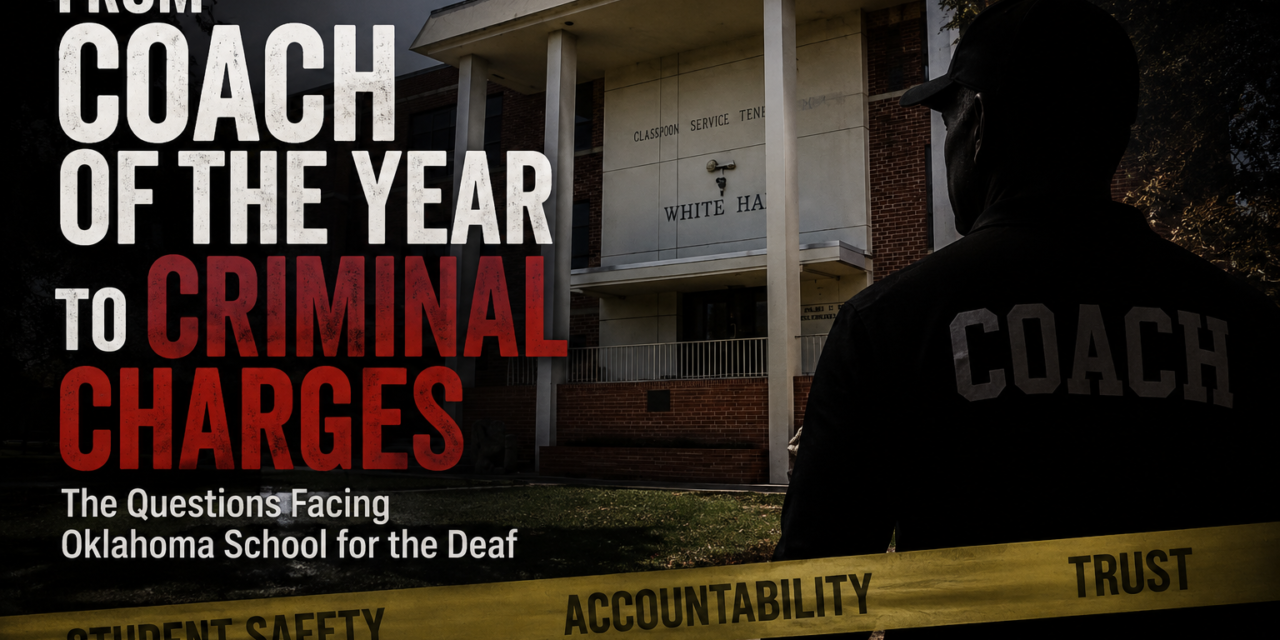
Only months ago, Sean Thomas Sledd was one of the most celebrated figures in Deaf athletics. As first-year head football coach at the Oklahoma School for the Deaf (OSD), he helped lead the Bison to their third consecutive Great Plains Schools for the Deaf football championship. In November 2024, Superintendent Heather Laine publicly praised Sledd and his coaching staff, saying their “leadership and dedication have made all the difference.” He was later recognized by the National Deaf Interscholastic Athletic Association (NDIAA) as its Division II Football Coach of the Year. Welcome to Oklahoma’s Official Web Site
Today, Sledd faces four felony charges, including first-degree rape and offenses involving child sexual abuse material. According to reporting by KFOR News 4, investigators allege he engaged in a secret sexual and romantic relationship with a Deaf student over the course of several years. Those allegations are now before the courts, where Sledd is presumed innocent unless and until proven guilty. Welcome to Oklahoma’s Official Web Site
The criminal charges themselves are significant, but the reporting raises questions that extend beyond one individual. According to KFOR, the former student reported the alleged abuse to the Sulphur Police Department in January. She told investigators she had known Sledd her entire life because their families knew each other. Police allege the relationship began in 2021 and continued until she graduated. The report further states that investigators are examining whether other individuals may have known about the alleged relationship and failed to act.
Perhaps the most troubling detail reported by KFOR is not one of the criminal allegations themselves, but what investigators say may have happened inside the school. According to the police report cited by KFOR, a staff member observed Sledd and the student being physically affectionate, confronted Sledd, and sent him out of the building. The alleged victim told investigators she believed that incident would expose the relationship, but said, “nothing ever happened.” Police are now investigating whether anyone with knowledge failed to take appropriate action.
The Oklahoma Department of Rehabilitation Services (ODRS), which oversees the Oklahoma School for the Deaf, issued a different timeline. Mark Beutler, director of communications for ODRS, told KFOR that “as soon as they learned of the investigation, Sledd was removed from the campus and is no longer employed.” That statement is important because it establishes the agency’s position regarding its response once it became aware of the police investigation. What remains unclear is the sequence of events leading up to that point, including when the alleged incident observed by a staff member occurred, who was informed, whether it was documented, and whether mandatory reporting procedures were followed.
These unanswered questions are where the public interest lies.
It is easy to focus on the dramatic contrast between a Coach of the Year award and subsequent criminal charges. That contrast understandably captures attention. Yet awards are based on what institutions know at the time they are presented. They recognize visible accomplishments, leadership, and athletic success. They are not investigations into an individual’s private conduct. Without evidence that school leadership knew of the allegations when Sledd received those honors, it would be unfair to suggest the recognition itself was improper.
The more important question is whether the systems designed to protect students functioned as intended.
If a staff member observed conduct serious enough to confront Sledd, what happened next?
Was the incident documented?
Was it reported to administrators?
Did it trigger an internal review?
Were mandatory reporting requirements considered?
Those are not accusations. They are questions that naturally arise whenever allegations involve educators entrusted with the care of children.
For the Deaf community, these questions resonate deeply because schools for the Deaf are more than educational institutions. They are cultural centers where generations of Deaf children have learned language, identity, leadership, and community. Students often spend far more time with teachers, coaches, dormitory staff, and mentors than they would in a traditional day school. That environment creates extraordinary opportunities for learning and belonging, but it also demands extraordinary accountability.
This is also not the first time allegations involving abuse at a school serving Deaf students have generated national attention. Over the years, multiple schools have faced criminal investigations, civil lawsuits, and allegations involving educators or staff members. Each case is unique and must be judged on its own facts. Still, together they highlight a broader challenge: safeguarding cannot depend solely on trust or reputation. It must depend on clear policies, accessible reporting systems, consistent oversight, and a willingness to investigate concerns promptly and transparently.
One of the greatest strengths of the Deaf community is its interconnectedness. Teachers become mentors. Coaches become lifelong role models. Former classmates become colleagues and friends. That closeness builds community, but it can also make difficult conversations more emotionally complicated. When allegations emerge, they rarely involve strangers. They involve people who have been admired, trusted, and respected for years. That reality makes accountability harder, but it also makes it more important.
As the criminal case against Sean Thomas Sledd moves through the justice system, the courts will determine whether the allegations are proven. The broader responsibility now belongs to the institutions that educate Deaf children and the communities that support them. The goal should not be to assign blame before all the facts are known. It should be to ask whether existing safeguards worked, whether warning signs were recognized, and whether every reasonable step was taken to protect students.
Championships and awards bring pride to a school. Accountability builds trust. In the end, protecting students will always be the achievement that matters most.





Recent Comments