
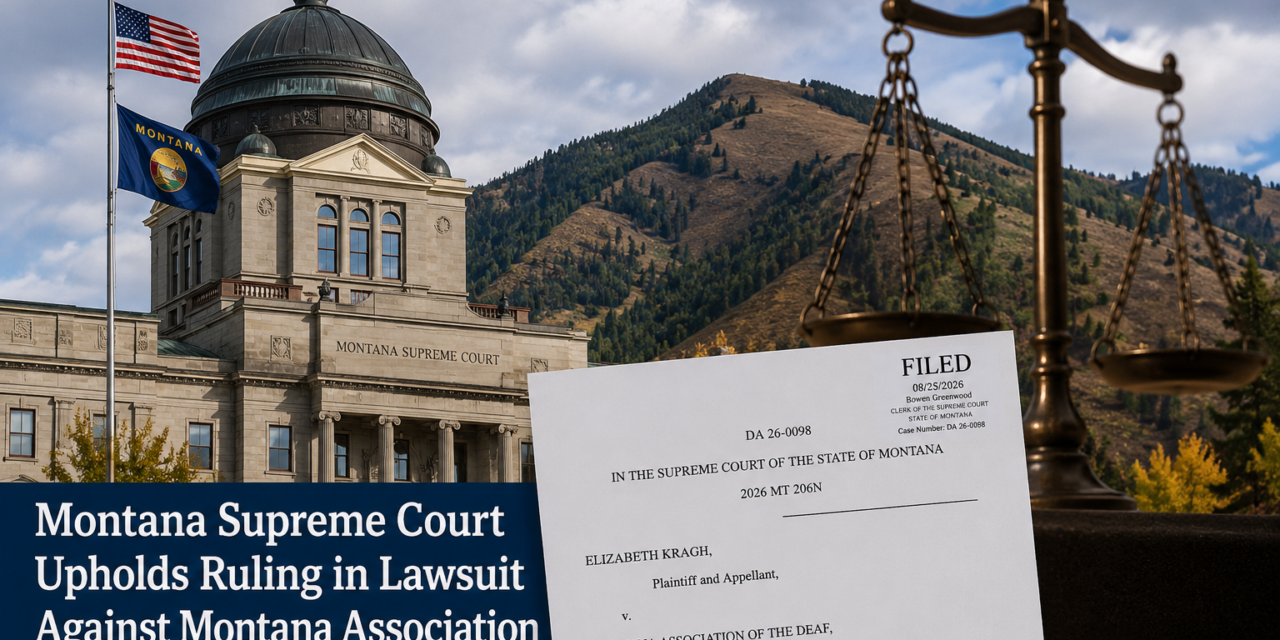
The Montana Supreme Court has upheld the dismissal of a lawsuit brought by Elizabeth Kragh against the Montana Association of the Deaf, rejecting her challenge to the organization’s handling of records, elections and financial oversight.
The unanimous decision, issued Aug. 25, affirmed a lower court ruling that had granted summary judgment to the Montana Association of the Deaf, or MAD.
Kragh, who represented herself in the appeal, has since spoken publicly about the decision, saying she felt the state’s highest court did not take her seriously.
The court’s written opinion, however, presents a more procedural account. The justices reviewed each of Kragh’s three claims, considered her objections to limits on discovery and concluded that the District Court had properly dismissed the case.
The dispute grew out of a series of disagreements between Kragh and MAD over access to organizational records, the manner in which officers were elected in 2023 and questions surrounding an $888.54 financial discrepancy.
A Dispute Over Records
Kragh alleged that MAD violated her statutory right to inspect and copy corporate records after she sought meeting minutes from the organization.
According to the Supreme Court, MAD later provided the requested minutes during discovery.
The District Court concluded that the claim had therefore become moot because Kragh had received the records she sought and had not identified an ongoing denial of access.
Kragh argued that the records were produced only after litigation began and that the lawsuit itself had prompted their release.
The Supreme Court nevertheless agreed with the lower court that there was no longer a live dispute over those particular records that required judicial intervention.
Questions About a 2023 Election
A second claim focused on MAD’s June 2023 election.
Kragh argued that officers had been selected by acclamation despite a provision in the organization’s bylaws requiring written ballots.
The Supreme Court noted that each office had only one candidate and that Kragh had attended the conference without objecting when the election took place.
The court also noted that Kragh did not seek monetary damages related to the election and that MAD conducted another election in 2025 in compliance with its bylaws.
The justices agreed with the District Court that Kragh had not demonstrated an injury that justified judicial intervention.
The ruling also relied in part on the legal doctrines of waiver and laches, pointing to Kragh’s failure to object at the time of the election and the nearly two-year period before the lawsuit was filed.
The court further cited the principle that courts generally avoid intervening in the internal affairs of private voluntary organizations unless circumstances such as fraud, arbitrariness or unreasonable conduct warrant doing so.
The $888.54 Discrepancy
The third claim concerned MAD’s financial oversight.
Kragh alleged that an $888.54 discrepancy in the organization’s financial reporting had not been adequately explained.
During discovery, MAD produced bank statements, ledgers and other financial records.
According to the Supreme Court, those records showed that the discrepancy resulted from comparing balances from two different dates. The organization’s president had referenced a May 1, 2023, balance during a March 2024 meeting instead of the Dec. 29, 2023, balance.
The difference, the court said, reflected income added during 2023.
MAD later corrected the meeting minutes, and its board ratified the correction.
Kragh raised additional concerns about other financial transactions, but the court said those allegations extended beyond the specific discrepancy identified in her original complaint.
The District Court had previously declined to allow the case to be expanded to include those broader allegations.
A Request for More Evidence
Kragh also argued that she should have been permitted to conduct additional discovery before the case was resolved.
She sought materials that included recordings of board meetings, internal communications and roughly a decade of bylaw history.
The District Court denied those requests.
The Supreme Court upheld that ruling, finding that Kragh had not identified with sufficient specificity what information she expected the additional materials to reveal or how that information would create a factual dispute requiring a trial.
Under summary judgment rules, a party opposing dismissal must present evidence showing a genuine dispute over facts that could affect the outcome of the case.
Speculation that additional evidence may exist is generally not enough.
The court concluded that Kragh had failed to present what it described as “material and substantial evidence” establishing such a dispute on any of her claims.
Different Interpretations of the Outcome
After the ruling, Kragh publicly described the experience in personal terms, saying she felt the Supreme Court did not take her seriously.
The distinction between that statement and the court’s written findings is significant.
The opinion does not suggest that the court refused to consider her arguments.
Instead, the justices reviewed the District Court’s ruling, discussed the factual record and addressed each of the claims raised in the appeal before concluding that the lower court had applied the law correctly.
The case was resolved through a memorandum opinion, which means the decision does not serve as precedent and generally may not be cited in future cases.
That designation does not indicate that the court viewed the litigant or the dispute as unworthy of consideration. The court explained that memorandum opinions are used when an issue is governed by settled law or a straightforward application of existing legal standards.
MAD also sought attorney fees connected to part of the appellate proceedings.
The Supreme Court denied that request.
Supporters Continue to Question MAD
Some of Kragh’s supporters have acknowledged the legal defeat while continuing to criticize MAD.
In a public Facebook post, Rita Brandborg wrote that the Montana Supreme Court had “ruled against Eliza in her appeal and affirmed the dismissal of her claims.”
Brandborg then described her own concerns about the organization, including a loss of trust and her allegation that she had been blocked from MAD’s website after expressing criticism.
She said she intended to step away from the organization while continuing to observe it from outside.
Her comments illustrate a distinction that extends beyond this particular lawsuit.
A legal ruling in favor of an organization does not resolve every question about its leadership, communication or relationship with members.
At the same time, dissatisfaction with an organization does not establish that a legal violation occurred.
Courts answer narrower questions.
In this case, the question before the Montana Supreme Court was not whether MAD had always governed effectively or whether every criticism of the organization was unfounded.
The question was whether the District Court had improperly granted summary judgment on the claims Kragh brought before it.
The Supreme Court concluded that it had not.
That leaves two separate conversations moving forward.
One concerns the legal record, which now shows that Kragh lost at the District Court level and that the Montana Supreme Court affirmed that decision.
The other concerns the broader debate over governance, transparency and trust within an organization serving Montana’s Deaf community.
Those debates may continue.
But they are not the same as the legal questions resolved by the court.
On the lawsuit itself, the state’s highest court was unequivocal.
The judgment was affirmed.


Recent Comments