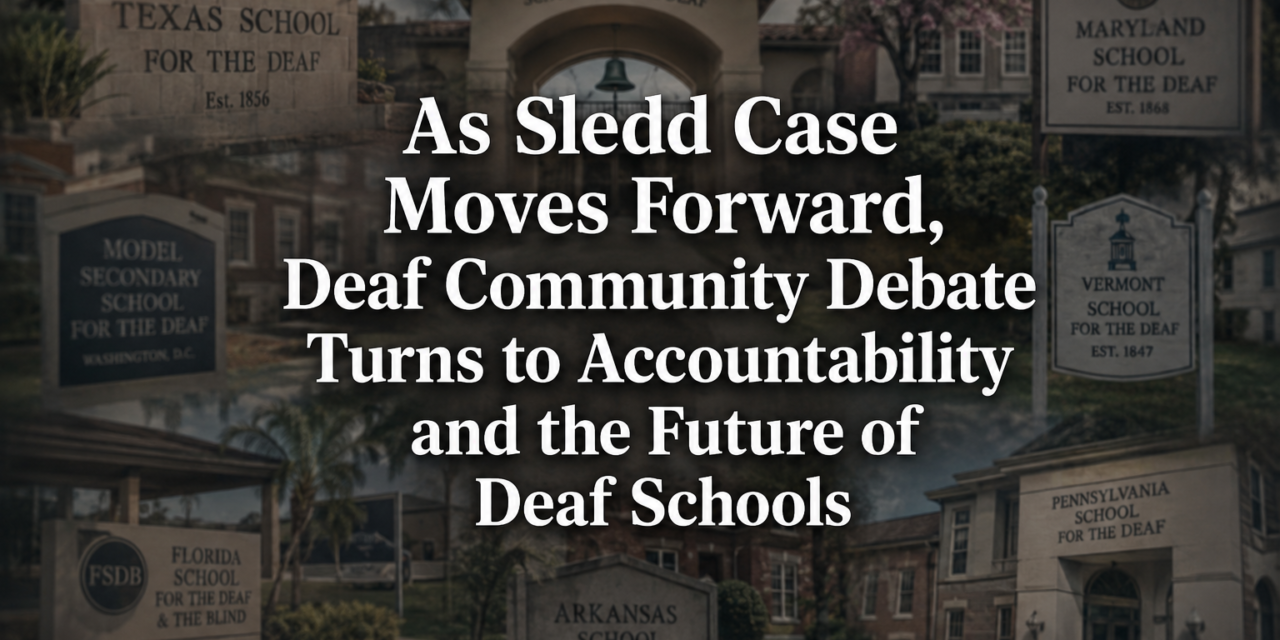
The criminal case against former Oklahoma School for the Deaf teacher and coach Sean Thomas Sledd is now moving forward after he surrendered to authorities and was released on a $275,000 bond. But outside the courtroom, another conversation is developing within the Deaf community.
Some reactions have focused on whether other adults knew about the alleged relationship and whether mandatory reporting requirements were followed. Others have pushed back against broader criticism of schools for the Deaf, particularly comments suggesting sexual abuse is uniquely a Deaf-school problem or that residential schools should be closed.
Those conversations do not have to compete with one another.
Sexual abuse is not exclusive to schools for the Deaf, and allegations against an employee do not establish that an entire school or educational model is unsafe. Deaf schools provide language access, cultural connection, education and social opportunities that many Deaf children cannot easily obtain elsewhere.
At the same time, defending Deaf education should not require defending every institution from scrutiny.
The Sledd case presents an especially complicated example because he appears to have deep roots at OSD. State archival material identifies Sledd as an OSD student as early as 2011. He later returned as an educator and coach. In November 2024, Superintendent Heather Laine publicly praised Sledd and his coaching staff after the school’s third consecutive Great Plains Schools for the Deaf football championship. By January 2025, OSD was reporting his National Deaf Interscholastic Athletic Association Division II Coach of the Year recognition to the Oklahoma Commission for Rehabilitation Services.
That kind of history matters when talking about power.
In small communities, authority does not always come from a job title. It can come from reputation, family relationships, athletic success, years of involvement or simply being someone everybody knows.
That can make allegations against respected community members difficult to process. People may struggle to reconcile the person they know with the conduct being alleged. Some may instinctively defend the institution because criticism of the school feels like criticism of Deaf education itself.
But accountability and support for Deaf schools are not opposites.
In fact, demanding strong mandatory reporting procedures, independent avenues for students to disclose abuse, relationships with Deaf victim advocacy organizations and meaningful oversight is one way of protecting Deaf schools.
The question should not be, “Are Deaf schools bad?”
It should be, “What safeguards make Deaf schools safer?”
And there is another question that cannot yet be answered.
ODRS says Sledd was removed from campus when officials learned of the police investigation. Earlier KFOR reporting, however, said police are investigating whether other people may have known about the alleged relationship and failed to act. According to the police report described by KFOR, a staff member allegedly witnessed physical behavior between Sledd and the student and confronted him.
Those facts do not establish that administrators knew or that mandatory reporting laws were violated.
They do establish why asking what happened next is appropriate.
Who was told? Was a report made? Was the incident documented? When did it occur? Did anyone else become aware of it?
Those are not attacks on Deaf schools.
They are questions asked because Deaf schools matter and because the children attending them deserve both language access and safety.


Recent Comments