As the National Association of the Deaf begins a new planning model, Beyond Access looks back at the priorities delegates adopted two years ago.
At the 2026 National Association of the Deaf (NAD) Council of Representatives (COR) meeting, delegates approved a new planning framework known as Community-Driven Commitments, signaling a shift away from the organization’s traditional biennial priority system.
That transition makes this an appropriate time to look back.
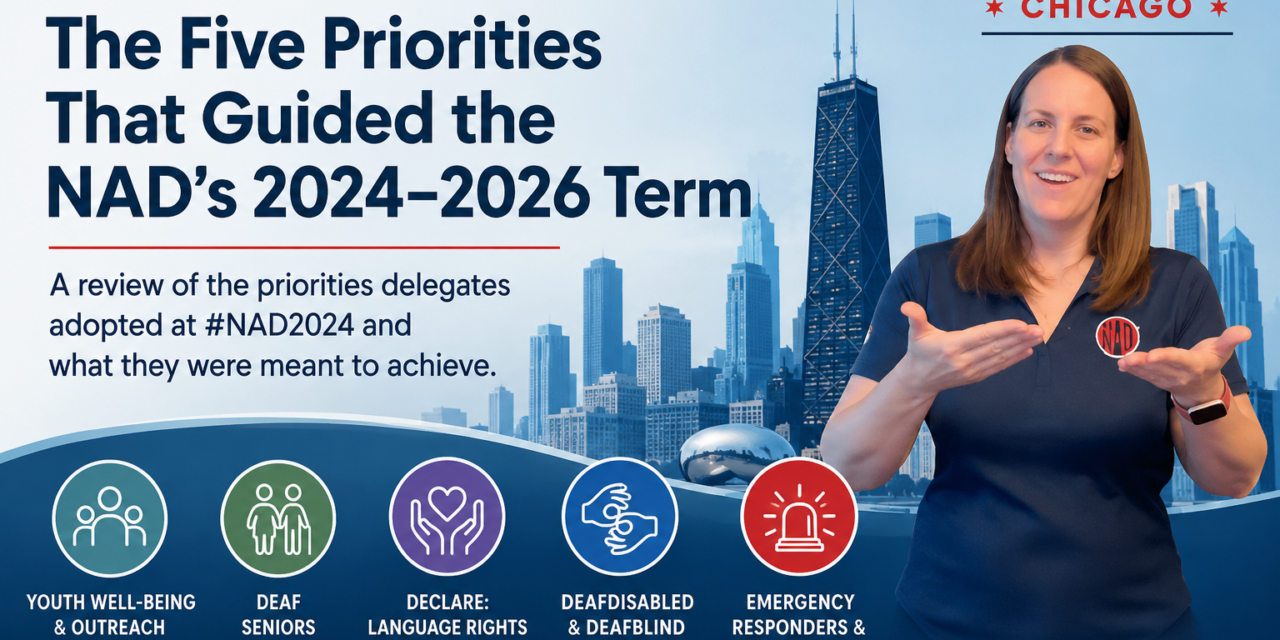
When delegates met in Chicago in July 2024, they were asked to identify the issues they believed should guide the organization’s work over the next two years. After discussion, debate, and voting, delegates adopted five priorities that addressed youth mental health, Deaf seniors, language deprivation, DeafBlind and DeafDisabled access, and emergency preparedness.
Those priorities became the roadmap for the NAD’s work during the 2024–2026 term.
A Continuation of Long-Term Work
One of the most notable aspects of the 2024 priorities is that several were not entirely new initiatives.
Instead, delegates recognized that many issues affecting the Deaf community require sustained work over multiple years.
Three of the five priorities specifically built upon earlier efforts.
The Deaf Youth Well-Being priority was renewed because committee members reported they needed additional time to continue developing the Deaf Youth Well-Being First Aid initiative, expand community outreach, collect data, and build additional resources.
The DECLARE: Deaf Children’s Language Rights Everywhere proposal grew directly from the previous ASL Resources for Deaf Babies priority. According to the proposal, more than 20 organizations worked together over two years to develop a coordinated movement focused on ending language deprivation through education, legislation, family programming, awareness, and systems change.
The Deaf Seniors priority also continued ongoing work through the NAD and the Deaf Seniors of America Taskforce, expanding its focus to include accessibility in assisted living facilities, nursing homes, rehabilitation centers, and home-based care.
Rather than beginning from scratch every two years, these proposals reflected an effort to build upon work already underway.
The Five Priorities
1. Address Deaf Youth Well-Being and Outreach Efforts
Delegates renewed this priority to continue developing the Deaf Youth Well-Being First Aid initiative and strengthen outreach to Deaf youth.
The proposal noted that committee members had already conducted webinars, presented at conferences, engaged community organizations, and begun developing resources. Additional time was requested to continue expanding those efforts.
The proposal also expressed concern about declining participation by Deaf youth in community organizations and emphasized the importance of engaging the next generation of leaders.
2. Deaf Seniors Issues
The second priority addressed barriers experienced by Deaf, DeafBlind, DeafDisabled, Hard of Hearing, and Late-Deafened seniors.
The proposal called for continued collaboration through the NAD/DSA Taskforce while expanding attention to accessibility in assisted living facilities, nursing homes, rehabilitation centers, centers for aging, and home caregiving.
The rationale emphasized that communication access remains a daily challenge for many older adults across the country.
3. DECLARE: Deaf Children’s Language Rights Everywhere
The third priority represented an expansion of previous work addressing language deprivation.
The proposal introduced DECLARE as a national movement designed to coordinate organizations working toward early language access for Deaf children.
Rather than focusing on a single program, DECLARE proposed building a Community of Practice that would align advocacy, legislation, education, family support, resource development, and public awareness efforts.
Its long-term goal was ambitious: ending language deprivation within a generation.
4. Access to Resources for DeafDisabled Citizens and Enhancing Services for DeafBlind Communities
Delegates also approved a priority focused on improving access for DeafBlind and DeafDisabled individuals.
The proposal identified barriers including limited culturally competent service providers, shortages of qualified interpreters, inconsistent transportation programs, and inadequate communication access during emergencies and other critical situations.
Among its proposed solutions were collaboration with the U.S. Department of Health and Human Services, interpreter and provider training, improved transportation support, and federal advocacy to establish funding for communication facilitators and transportation services for DeafBlind individuals.
5. Deaf Community Needs: Access to Emergency Responders and Emergency Announcements and Notifications
The fifth priority focused on emergency preparedness and public safety.
Delegates cited concerns that many public facilities lack accessible emergency notification systems and that first responders often have limited training in communicating with Deaf, DeafBlind, DeafDisabled, Hard of Hearing, and Late-Deafened individuals.
The proposal called for developing best practices, educational materials, position statements, webinars, and advocacy resources for state associations while encouraging stronger federal protections related to emergency communication access.
Looking Back Is Not Always Easy
Reviewing the history of the NAD’s priority system revealed another challenge.
While the individual 2024–2026 priority page remains publicly available, the webpage referenced as the “NAD Board Priorities History and Overview” was not publicly accessible at the time of this review.
As a result, members seeking to understand how priorities have evolved over time cannot simply navigate through a centralized historical archive.
Instead, reconstructing the history requires reviewing multiple sources, including Council of Representatives minutes, Board meeting minutes, annual reports, NADmag, Board updates, and archived webpages.
Likewise, there is currently no single public page that presents the history of each biennial priority alongside committee leadership, progress updates, and final outcomes in one location.
This observation should not be interpreted to mean the information does not exist. Rather, based on Beyond Access’s review of publicly available materials, the historical record is dispersed across numerous documents instead of being organized in one publicly accessible resource.
For members, delegates, researchers, and future leaders, centralized historical records can provide valuable context for understanding how organizational priorities develop, continue across multiple years, and ultimately shape the direction of the association.
Looking Ahead
The five priorities adopted in 2024 reflected what delegates believed were the most pressing issues facing the Deaf community during the 2024–2026 term.
Two years later, the NAD has begun a new chapter by adopting Community-Driven Commitments as its planning framework.
This article is the first in a Beyond Access series examining that transition.
The next article will explore what the publicly available record reveals about the work completed under the 2024–2026 priorities before delegates voted to move in a new direction.





Recent Comments