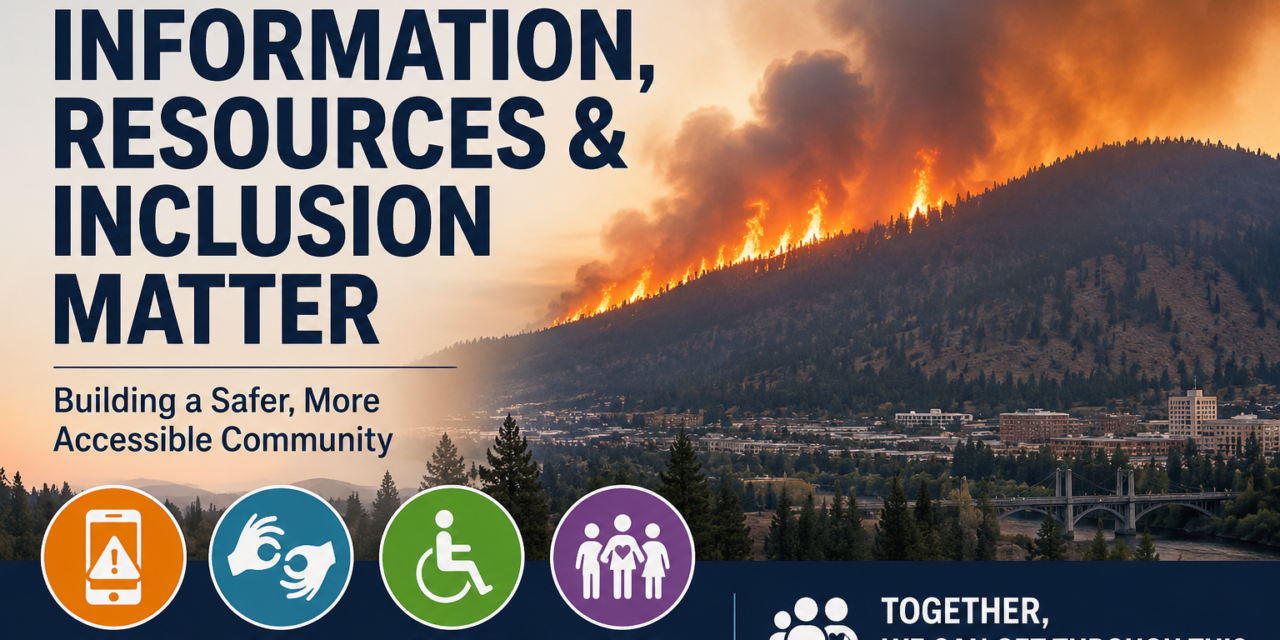
As wildfires continue to devastate the Spokane region, emergency responders are working around the clock to contain multiple fires that have destroyed hundreds of homes, displaced tens of thousands of residents, and become one of Washington’s most significant wildfire disasters in recent years.
But beyond the flames lies another challenge that receives far less attention.
For Deaf, DeafBlind, Hard of Hearing, and disabled residents, surviving a disaster depends not only on evacuation orders and firefighting efforts, but also on whether emergency information is accessible, timely, and available in multiple formats.
That reality was the focus of a recent interview with Jim House, Disability and Access and Functional Needs (AFN) Integration Manager for the Coalition on Inclusive Emergency Planning (CIEP).
His message was clear.
Washington has made meaningful progress in emergency accessibility, but the Spokane fires demonstrate there is still considerable work ahead.
Who Is Jim House?
House serves as the Disability and Access and Functional Needs Integration Manager for the Coalition on Inclusive Emergency Planning (CIEP), a statewide coalition operated through the Washington Statewide Independent Living Council (WASILC) and funded by the Washington State Department of Health.
CIEP has spent more than a decade bringing together disability organizations, emergency managers, public health agencies, advocates, tribal governments, and community partners to improve disaster preparedness and response for people with disabilities throughout Washington.
The coalition meets regularly to evaluate emergency planning, identify accessibility barriers, and recommend improvements before, during, and after disasters.
Why Disability Inclusion Matters During Emergencies
One of the most sobering facts House shared is that research consistently shows people with disabilities are up to four times more likely to die or be injured during disasters.
Many people assume accessibility means simply providing an American Sign Language interpreter.
House explained that emergencies are much more complex.
Some individuals require interpreters.
Others rely on captioning.
Some need accessible transportation.
Others depend on medications, medical equipment, service animals, mobility devices, electricity for life-sustaining equipment, or assistance maintaining independence while living in shelters.
That broader approach is reflected in the CMIST Framework, which guides CIEP’s work.
CMIST stands for:
- Communication
- Maintaining Health
- Independence
- Safety, Support, and Self-Determination
- Transportation
Rather than focusing on a single disability or accommodation, the framework recognizes that every person experiences emergencies differently and that emergency planning must account for a wide range of access and functional needs.
The Spokane Fires Revealed Familiar Accessibility Challenges
During the interview, House acknowledged that the Spokane fires have already exposed several accessibility gaps.
Early emergency notifications relied primarily on traditional alert systems and telephone-based communication.
ASL access was not immediately available during initial emergency messaging.
One notable improvement came during a later gubernatorial press conference, when an ASL interpreter was finally included alongside state officials.
House described that as significant progress compared to previous disasters.
However, he also noted that the interpreter’s video feed frequently froze, became blurry, or was difficult to see.
The effort represented progress, but it also demonstrated that simply including an interpreter is not enough if people cannot clearly view the interpretation.
“There is still more work to do,” House explained.
The Same Problems Continue to Surface
The Spokane fires are not the first emergency to expose accessibility issues.
Following Washington’s historic winter flooding during late 2025, CIEP completed an extensive After-Action Review examining how emergency response systems served people with disabilities.
The report documented recurring concerns, including:
- Inconsistent ASL interpretation during emergency briefings
- inaccessible emergency communications
- inconsistent captioning
- barriers affecting DeafBlind residents
- transportation challenges
- shelter accessibility concerns
- Inconsistent disability planning among counties
- limited disability representation during emergency operations
The report concludes that many of these barriers persist from disaster to disaster because successful accessibility practices have not yet been standardized across emergency management.
House confirmed that CIEP will conduct another after-action review once the Spokane wildfire response concludes, allowing agencies and community organizations to evaluate what worked, identify shortcomings, and recommend improvements for future emergencies.
Accessibility Means More Than ASL
One important point House emphasized is that accessibility should never be viewed as a single accommodation.
Not every Deaf person uses ASL.
Not every DeafBlind person communicates the same way.
Some individuals benefit most from:
- ASL interpretation
- live captioning
- text alerts
- plain language information
- visual graphics
- tactile communication
- support service providers
Emergency communication should include multiple accessible formats whenever possible so individuals can receive information in the way that best meets their needs.
Building Relationships Before Disaster Strikes
House also highlighted the importance of preparing long before an emergency occurs.
Over the years, CIEP has worked closely with emergency management agencies across Washington by providing workshops, training exercises, and disability inclusion education.
Last November alone, approximately 45 Deaf community members participated in emergency preparedness training.
Those existing relationships, House said, helped emergency managers better understand accessibility needs during the Spokane wildfire response.
The lesson is straightforward.
Accessibility cannot begin when the disaster starts.
It must already be part of emergency planning.
Resources Available for Spokane Fire Survivors
While emergency crews continue battling the fires, numerous organizations are providing immediate assistance to those affected.
Emergency Shelter
The Spokane Convention Center remains open as an emergency shelter for individuals and families forced to evacuate.
The Spokane County Fairgrounds is also accepting horses and other large animals displaced by the fires.
Showers and Basic Needs
The YMCA of the Inland Northwest has opened all locations Monday through Friday from 8:00 a.m. to 5:00 p.m. for wildfire survivors needing access to showers and basic facilities.
Emergency Child Care
To assist families managing evacuations, insurance claims, and recovery efforts, Spokane Public Schools is offering a free emergency drop-in program for children ages four and older.
The program operates Monday through Friday from 11:00 a.m. to 3:00 p.m. at Shadle Park High School.
American Red Cross
The American Red Cross is providing emergency assistance for individuals affected by the fires.
Anyone needing assistance can contact the organization at 1-800-733-2763.
Financial Assistance
The Innovia Foundation has established the Spokane Complex Wildfire Response Fund to support individuals, families, and communities impacted by the disaster through charitable donations.
Emergency Information
Residents should continue monitoring Spokane County Emergency Management for evacuation notices, road closures, shelter information, and preparedness guidance.
Anyone who has not already done so should enroll in Alert Spokane, the county’s official emergency notification system, to receive emergency alerts directly on their mobile devices.
Watch Duty
Many residents have also turned to Watch Duty, a free wildfire tracking application that provides near real-time information about active fires, evacuation zones, containment updates, road closures, and firefighting activity.
While Watch Duty is not an official government alert system, it has become an important supplemental resource during the Spokane fires.
Practical Advice from Jim House
House offered several recommendations for both current and future emergencies:
- Keep your phone charged and monitor emergency alerts regularly.
- If you do not have reliable access to emergency notifications, establish a buddy system with family, friends, neighbors, or coworkers.
- Follow official evacuation orders and stay out of restricted areas until authorities declare them safe.
- Check on Deaf, DeafBlind, disabled, and older community members who may need additional assistance.
- Request accommodations directly from emergency shelters or emergency management officials when needed. Providing accessible communication is their responsibility.
- Contact the Washington Office of the Deaf and Hard of Hearing or local emergency management if communication barriers arise during an emergency.
Looking Ahead
The Spokane fires will eventually be contained.
Homes will be rebuilt.
Roads will reopen.
Recovery funds will begin reaching survivors.
Yet the lessons from this disaster extend beyond acres burned or structures lost.
Each major emergency offers an opportunity to examine whether every member of the community had equal access to life-saving information.
The Spokane response demonstrated encouraging progress. Interpreters were included in major press conferences, disability organizations were actively engaged, and years of relationship-building between emergency managers and advocates strengthened coordination.
At the same time, recurring challenges remain.
Accessible emergency communication cannot depend on last-minute decisions or technical luck. It must be woven into emergency planning from the very beginning.
As CIEP prepares another after-action review, the question is no longer whether accessibility matters.
The question is whether the lessons learned from Spokane will finally become permanent improvements before the next disaster arrives.
Further Reading
Readers interested in learning more about inclusive emergency management and disaster accessibility may wish to explore the following resources:
- Coalition on Inclusive Emergency Planning (CIEP) – Information about Washington’s statewide disability-inclusive emergency planning efforts.
- Washington Statewide Independent Living Council (WASILC) – Resources on disability policy and independent living initiatives.
- CIEP AFN CMIST After-Action Review (2025 Winter Weather Disaster) – A comprehensive review of Washington’s emergency response through the Communication, Maintaining Health, Independence, Safety/Support/Self-Determination, and Transportation framework, including recommendations that remain relevant during the Spokane wildfire response.
- Spokane County Emergency Management – Current evacuation information, preparedness guidance, and emergency resources.
- Alert Spokane – Spokane County’s official emergency notification system.
- Washington State Office of the Deaf and Hard of Hearing (ODHH) – Resources supporting communication access before, during, and after emergencies.
- Watch Duty – Free wildfire tracking application providing near real-time fire activity and evacuation updates.
- National Association of the Deaf (NAD) Emergency Preparedness Resources – National guidance on emergency planning and communication accessibility for Deaf and Hard of Hearing communities.
This disaster has reinforced an important lesson: emergency preparedness is not only about fighting fires. It is about ensuring that every person, regardless of disability or communication method, has an equal opportunity to receive information, make informed decisions, and stay safe when it matters most.





Recent Comments